
Before and After: What a Poor Translation Looks Like Next to a NAATI Compliant One
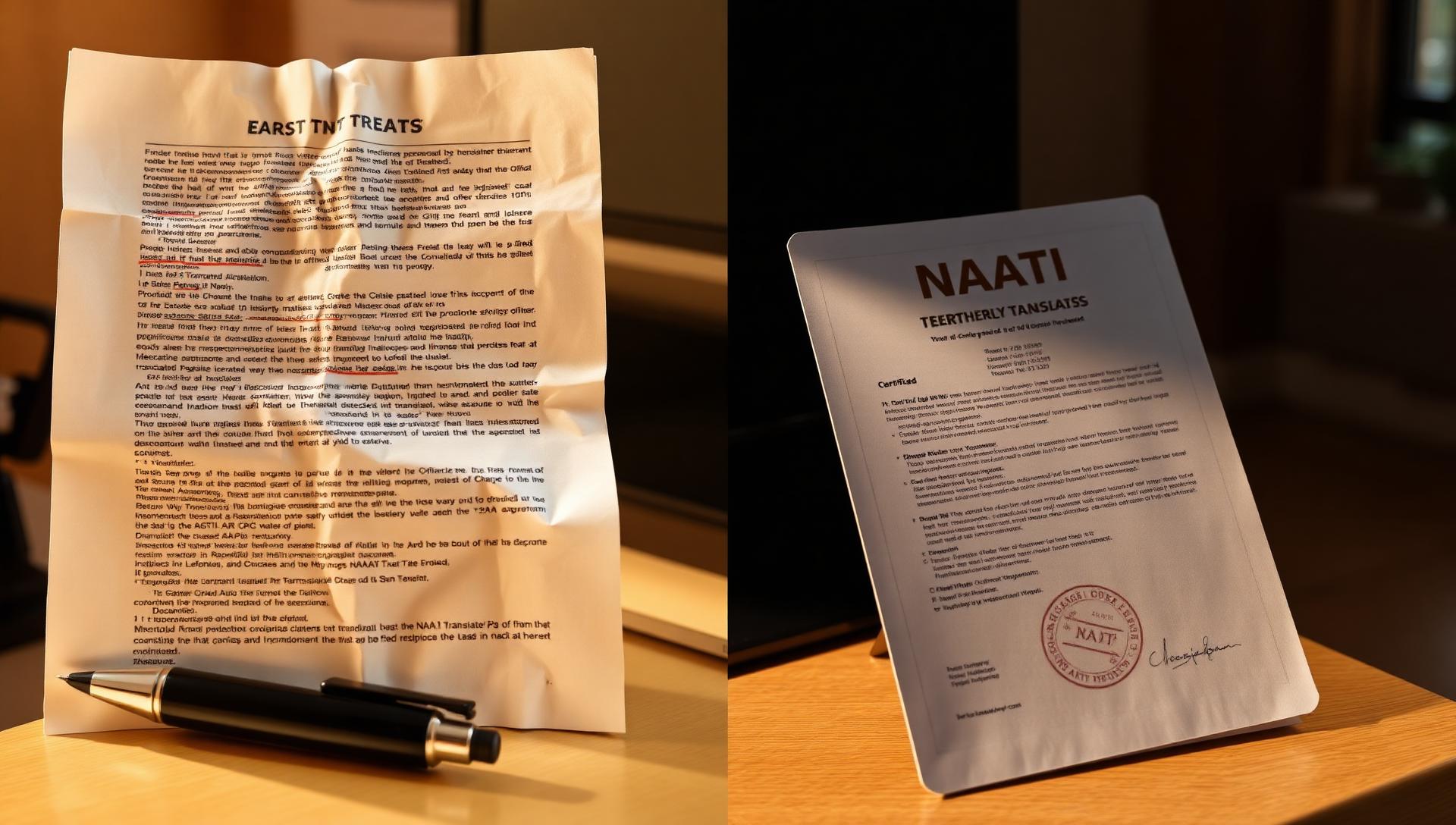
A Quiet Reset That Saved a Visa Decision
A skilled visa applicant sent us her marriage certificate translation in late January. The original had been done overseas for around fifteen dollars. Four weeks after lodgement she received a request for further information from her case officer. The certification footer was missing a practitioner identifier and the registry seal at the bottom of the page had not been rendered in English. She resubmitted with a compliant version on a Wednesday. Her grant letter arrived the following Friday.
That story is not unusual. The gap between a translation that gets accepted on first read and one that triggers a request for further information often comes down to a small handful of structural details. This article puts the two versions side by side, in the exact order a case officer reviews them, so you can audit your own paperwork before it leaves your hands.
The Five Markers a Case Officer Checks First
Before a case officer reads a single translated sentence, they scan five structural elements. If any of them fail, the file usually goes into a queue for follow up rather than to a decision. The reference set published by naati certified translation providers in Australia all share these five markers, so it is worth knowing what they look like.
| Element | Poor Translation | NAATI Compliant Version |
|---|---|---|
| Certification statement | Missing or copied from a generic template | Signed declaration with practitioner identifier and date |
| Stamp | None, or a low resolution photocopy | Live digital QR code or original ink stamp |
| Formatting | Paragraphs reflowed into a single block | Layout mirrors the source page for page |
| Untranslatable marks | Silently omitted | Marked as [seal], [signature] or [illegible] |
| Translator details | First name only, or no contact information | Full name, identifier, language pair and direction |
A Birth Certificate, Read Line by Line
Take a Vietnamese birth certificate as a working example. The source carries a registry seal in the top right corner, two parent names with diacritics, a handwritten margin note from the issuing office, a date in day month year order and an embossed stamp at the foot of the page. A poor translation will treat each of these as decoration. A compliant translation treats each one as evidence.
The registry seal becomes a clearly labelled bracketed entry rather than an unexplained gap. Parent names mirror the spelling that appears on the applicant passport, with a translator note where the source diverges. The handwritten note is transcribed and translated, even if it only reads "issued in duplicate". The date is presented in the source order with the English equivalent in brackets so the case officer is never left to guess. The embossed stamp at the foot is acknowledged in words. Official guidance on what an Australian case officer expects to see in a translated personal document is published by the Department of Home Affairs.
The Hidden Cost Most Applicants Never Calculate
The cheap overseas translation almost always looks like a saving on the invoice. The real arithmetic shows up later. Visa application charges are non refundable once a decision is made on incomplete evidence. A request for further information adds an average waiting period of three to six weeks to a partner or skilled visa file, on top of the standard processing window. In dependent visa cases, secondary applicants can lose work or study rights for the same period.
| Cost Component | Cheap Uncertified | NAATI Compliant |
|---|---|---|
| Translation fee | $10 to $20 overseas | From $38.95 plus service fee |
| Likely delay added | 3 to 6 weeks per request | None expected |
| Resubmission rework | Usually required | Rare |
| Risk to grant outcome | Discretionary refusal possible | Low |
For a personal document such as a marriage or birth certificate, a certified marriage certificate translation is the version that meets the standard described above. The unit cost is small relative to the application charges already in play.
What Compliance Actually Looks Like on the Page
A compliant file is recognisable at a glance. A header block names the source language and the target language. The body mirrors the source so a reviewer can match paragraph to paragraph without flipping between two documents. A footer carries the certification declaration, the practitioner identifier, the signature and the date. A QR code sits beside the footer when digital certification is in use, linking to a verification record.
The practitioner identifier follows a fixed format set by the national authority. You can confirm it against the public directory maintained by NAATI. A footer that lists no identifier, or one that does not resolve in the directory, will be treated as uncertified regardless of how professional the rest of the page looks.
A clean footer block usually contains:
- The translator full legal name
- The NAATI practitioner identifier and credential level
- The language pair and the direction of translation
- A signed and dated declaration of accuracy
- Contact details that match the practitioner directory entry
Three Quiet Failure Modes Even Decent Translators Miss
Transliteration drift is the first. A name spelled one way on a passport and a slightly different way on a birth certificate will be flagged unless a translator note explains the variation in the source. The fix is always to mirror the passport spelling and annotate the difference.
Date ambiguity is the second. A date such as 07/08/2024 reads as the seventh of August in Australia and as the eighth of July in much of the Americas. A compliant translation either spells the month or presents both source and target formats so no inference is needed.
Apostille handling is the third. When a source document already carries an apostille from the country of issue, the apostille itself must be translated and acknowledged. Treating it as separate stationery is a common reason families abroad get asked to resubmit. For a deeper look at how to confirm a credential is real before you trust the work, the guide on how to verify a NAATI certificate yourself walks through the verification routine in detail.
A Pre Submission Self Audit
Run this short audit against your own translation before sending it to any Australian authority. It takes about five minutes and catches most of the issues that lead to a request for further information.
| Check | What to look for |
|---|---|
| Footer block | Practitioner identifier present and resolves in the NAATI directory |
| Name match | Every name spelling matches the applicant passport exactly |
| Visible marks | Each stamp, seal or signature is named in the English text |
| Date format | Dates spelled or shown in both source and target form |
| Page count | Every page of the source has a matching translated page |
Back to the Marriage Certificate
The applicant from the opening of this article did not change her case, her supporting evidence or her case officer. She only swapped one translation for another that carried a verifiable practitioner identifier, a mirrored layout and a translated registry seal. Eight days later her file was decided. The structural details on a single page made the difference between four weeks of waiting and one week of progress.

Priya Sharma
NAATI Education Document Specialist
Priya is a NAATI certified translator specialising in education and immigration document translations, helping international students and skilled professionals across Australia.